


Email marketing remains a powerhouse in digital outreach. It’s projected that by 2025, over 4.6 billion people will be using email worldwide. Yet surprisingly, many marketers treat email campaigns as an afterthought. Instead of putting their efforts into creating captivating content, they often default to generic messages. The shocking truth is that emails with personalized content have a staggering 29 percent higher open rate. This reveals an incredible opportunity for businesses to boost engagement and conversions by crafting tailored messages that speak directly to the reader’s interests.
Table of Contents
- Effective Email Marketing Foundations
- Crafting Engaging Email Content
- Personalization And List Segmentation
- Analyzing Campaign Performance Data
Quick Summary
| Takeaway | Explanation |
|---|---|
| Building a Quality Email List is Essential | Focus on list quality over quantity by using a double opt-in process and regularly cleaning your list to enhance deliverability and engagement. |
| Prioritize Compliance and Trust Building | Ensure transparency in communications, respect user data privacy, and include your physical business address to build credibility with subscribers. |
| Implement Hyper-Personalization | Go beyond basic personalization; use behavioral data and strategic segmentation to create tailored messages that resonate with diverse segments of your audience. |
| Incorporate Interactive Elements | Enhance engagement with interactive content such as videos, polls, and image carousels, ensuring compatibility across all devices, especially mobile. |
| Analyze and Act on Performance Data | Track key metrics like open rates, click-through rates, and conversion rates; regularly review and test strategies to refine and improve future campaigns. |
Effective Email Marketing Foundations
Building a solid foundation is crucial for any effective email marketing strategy. Without the right groundwork, even the most creative campaigns can fall flat. For businesses in Cape Town looking to elevate their digital presence, mastering these fundamentals can create significant competitive advantages in connecting with both local and international audiences.
Building a Quality Email List
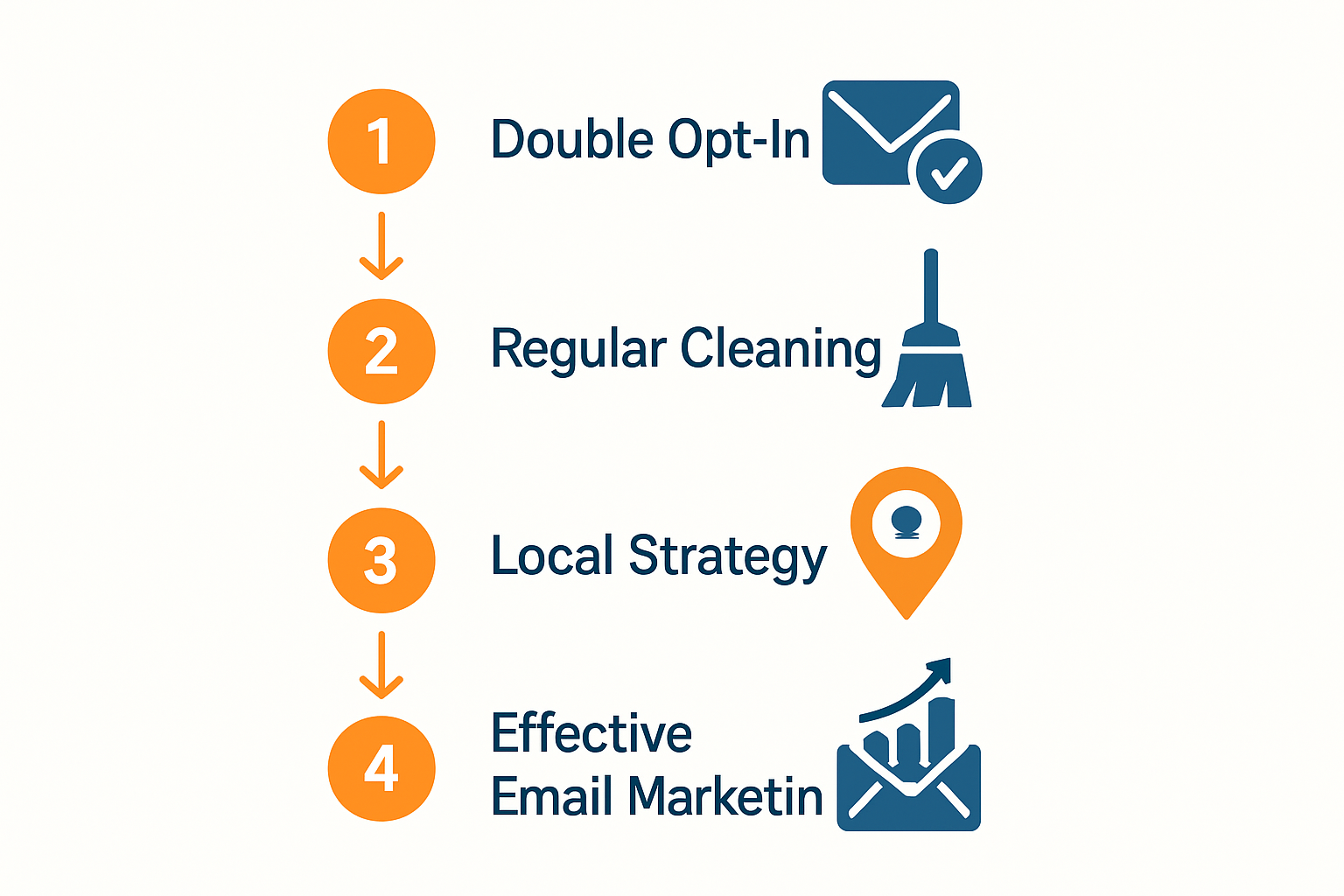
The backbone of effective email marketing starts with who you’re sending to. A common misconception is that bigger lists automatically yield better results. In reality, list quality trumps quantity every time.
Start by implementing a double opt-in process for new subscribers. This two-step verification ensures that only genuinely interested prospects join your list, significantly reducing bounce rates and improving deliverability. According to FireDrum Email Marketing, maintaining a clean and engaged email list through regular removal of inactive subscribers is foundational for improving deliverability and engagement in 2025.
For Cape Town businesses, consider local-focused list building strategies such as:
- In-store signup opportunities with clear value propositions (immediate benefits for joining)
- Cape Town business networking events with digital follow-ups
- South African market-specific lead magnets that address regional pain points
Regularly clean your list by removing unengaged subscribers after appropriate re-engagement attempts. While it might seem counterintuitive to reduce your subscriber count, delivery rates and engagement metrics will improve dramatically.
Compliance and Trust Building
In today’s privacy-conscious world, compliance isn’t just about avoiding penalties—it’s about building trust. South African businesses must navigate both local regulations and international standards like GDPR if they have European subscribers.
Transparency forms the foundation of trust in email marketing. Clearly communicate what subscribers can expect in terms of content and frequency. Make unsubscribing simple and honor preferences immediately. As email marketing continues to evolve, respecting user data, obtaining explicit consent for communications, and balancing personalization with privacy will become even more crucial in compliance with evolving data regulations.
Include your physical Cape Town business address in every email—not just for compliance, but to reinforce your local presence and build credibility with your audience. This small detail can significantly increase trust among local customers who value supporting South African businesses.
Crafting Compelling Content Architecture
Even with a perfect list and impeccable compliance, your efforts fall flat without engaging content. Effective email marketing hinges on delivering value with every send.
Develop a clear content strategy with distinct email types: promotional offers, educational content, company updates, and customer appreciation messages. Each serves a different purpose in your overall marketing strategy.
When creating emails for Cape Town audiences, remember that subject lines make or break open rates. Aim for 6-10 words that create curiosity or highlight clear value. Avoid spam triggers like excessive capitalization or misleading promises.
Structure your emails with a logical flow: a compelling headline, concise value proposition, supporting details, and a single, clear call to action. According to email marketing experts, crafting compelling content—including short, relevant subject lines, concise messaging, and clear calls to action—remains a core pillar for engaging subscribers and driving email marketing success.
The most effective emails for high-end Cape Town businesses maintain brand consistency while delivering unexpected value. Whether that’s exclusive insights into local market trends, early access to premium services, or curated recommendations relevant to the South African context, each email should reinforce why subscribing was worthwhile.
By focusing on these foundational elements—building quality lists, establishing trust through compliance, and creating compelling content architectures—Cape Town businesses can develop email marketing programs that don’t just reach inboxes but actually resonate with recipients. The businesses that master these fundamentals create sustainable channels for growth that continue delivering results long after each campaign ends.
Crafting Engaging Email Content
The difference between emails that convert and those that get deleted often comes down to content quality. For Cape Town businesses competing for attention in crowded inboxes, crafting truly engaging email content is no longer optional—it’s essential for effective email marketing success.

Personalization Beyond First Names
Basic personalization like including a recipient’s first name is now the bare minimum. Today’s sophisticated email subscribers expect content that feels individually relevant to their specific needs and interests.
According to Everything PR, by 2025, hyper-personalization in email content will significantly increase engagement and conversion rates. This goes beyond simple name insertion to incorporate behavioral data, purchase history, and even psychographics to create highly relevant messaging.
For Cape Town service-based businesses, this might mean segmenting subscribers based on:
- Previous service interactions (specific treatments or consultations)
- Neighborhood or district within Cape Town
- Price sensitivity or typical spending patterns
- Referral source or industry connections
This deeper personalization creates immediate relevance. A luxury hotel in Camps Bay can send entirely different content to corporate clients booking conference facilities versus international tourists planning holiday stays—with each receiving information perfectly aligned to their specific interests.
Interactive Elements That Demand Engagement
Static, text-heavy emails are increasingly ignored in favor of content that invites interaction. Research shows that 91% of consumers prefer interactive email content, yet many marketers still underutilize this powerful engagement tool, according to Hurrdat Marketing.
Interactive elements worth incorporating include:
- Embedded video showcasing Cape Town locations or services
- Interactive image carousels featuring product variations
- Polls asking for preferences on upcoming events or offerings
- Calculators that help estimate service costs or benefits
For example, a Cape Town property management firm might include an interactive calculator allowing recipients to estimate rental yields in different neighborhoods, or a restaurant could embed a short video of their chef preparing a signature South African dish. These elements transform passive reading into active engagement with your brand.
When designing these interactive elements, ensure they work across all devices. Many Cape Town professionals check email primarily on mobile devices, so responsive design is crucial for effective email marketing performance.
Storytelling That Resonates Locally
Humans are hardwired to respond to stories. In email marketing, storytelling creates emotional connections that facts and features alone cannot achieve. For Cape Town businesses, incorporating local narrative elements creates immediate resonance with your audience.
Effective email storytelling begins with understanding your brand’s unique narrative and how it intersects with local Cape Town culture and values. Are you a family business with deep roots in the Western Cape? A newcomer bringing innovative approaches to traditional industries? A luxury brand celebrating South African craftsmanship?
Consider these storytelling approaches for Cape Town businesses:
- Customer journey narratives featuring real local clients
- Behind-the-scenes glimpses into your Cape Town operations
- Content that connects your services to Cape Town landmarks or events
- Stories highlighting community involvement or sustainability initiatives
The deployment of dynamic content and adaptive messaging, enabled by AI, allows for individualized content such as product recommendations and optimized sending times. This results in improved open rates and user satisfaction, creating a more effective email marketing strategy that feels personally crafted for each recipient.
For example, a Cape Town tour operator might share the story of how they developed a unique neighborhood tour after conversations with local residents, complete with photos and testimonials. This narrative approach creates authentic connections that generic promotional content simply cannot match.
By implementing hyper-personalization, interactive elements, and compelling local storytelling, Cape Town businesses can transform their email marketing from forgettable to unmissable. The key is understanding that effective email content isn’t just about what you want to say—it’s about creating experiences that recipients actively want to engage with and share. When your subscribers begin looking forward to your emails rather than filtering them out, you’ve mastered the art of crafting truly engaging email content.
Personalization and List Segmentation
The days of sending identical email content to your entire subscriber base are long gone. For Cape Town businesses aiming to maximize their return on investment, mastering personalization and list segmentation is the key to creating effective email marketing campaigns that truly resonate with recipients.
The Power of Strategic Segmentation
List segmentation involves dividing your email subscribers into smaller, more focused groups based on specific criteria. This approach allows you to tailor messages precisely to each segment’s interests and needs, dramatically improving engagement metrics.
While we’ve touched on basic segmentation previously, successful Cape Town businesses are now implementing more sophisticated approaches. According to Accelerant Research, by 2025, successful businesses will be mastering audience segmentation based on behavior, preferences, and needs—moving beyond basic demographics to build dynamic segments that adapt to evolving customer behavior.
For Cape Town service providers, consider these advanced segmentation strategies:
- Engagement-based segments (highly engaged, moderately engaged, at-risk)
- Purchase cycle positioning (new prospects, recent customers, loyal regulars)
- Service preference segments (specific offerings they’ve shown interest in)
- Value-based segments (premium clients vs. entry-level customers)
A Cape Town high-end restaurant, for example, might segment subscribers based on dining preferences (seafood enthusiasts vs. wine connoisseurs), frequency of visits (regular patrons vs. occasional visitors), and even seating preferences (ocean view tables vs. private dining rooms).
The goal is to create segments specific enough to be meaningful but broad enough to be manageable. For most Cape Town businesses, starting with 4-6 core segments provides the right balance between personalization and practicality.
Behavioral Triggers and Automation
Segmentation reaches its full potential when combined with behavioral triggers—automated emails sent in response to specific subscriber actions. These create timely, relevant communications that feel perfectly aligned with the customer’s journey.
Common behavioral triggers for Cape Town businesses include:
- Welcome sequences for new subscribers introducing your Cape Town brand story
- Browse or service inquiry follow-ups for website visitors who showed interest
- Post-purchase sequences with relevant cross-sells based on Cape Town preferences
- Re-engagement campaigns for previously active local customers
The magic happens when these triggers incorporate segment-specific content. For instance, a Cape Town tourism business might create different welcome sequences for international visitors planning first-time trips versus local residents interested in specialty tours, each addressing unique concerns and opportunities.
Studies show that 78% of consumers will only engage with an offer if it has been personalized to their previous engagements with a brand, highlighting the critical importance of these tailored communications.
Personalization That Feels Human, Not Mechanical
Effective personalization goes far beyond inserting a customer’s name in the subject line (though that’s still important—Omnisend reports more than 80% of marketers see performance improvements with subject line personalization).
True personalization creates the feeling that each email was crafted specifically for the recipient. For Cape Town businesses, this means incorporating local context and cultural nuances that resonate with your audience.
Implement these advanced personalization tactics:
- Reference recent local Cape Town events or seasonal changes relevant to your industry
- Acknowledge loyalty milestones with personalized thank-you messages from your team
- Tailor product or service recommendations based on previous interactions
- Adjust tone and content depth based on the recipient’s engagement history
A luxury Cape Town jewelry designer might personalize emails by referencing a client’s previous purchase anniversary, suggesting complementary pieces that match their established style preferences, and including a personal note from their regular sales consultant.
When implementing personalization, always ensure you have the data to support it. Nothing undermines customer trust faster than personalization attempts based on incorrect information. Start with the data points you’re confident about, then gradually enhance your personalization as you gather more reliable customer insights.
The most sophisticated Cape Town businesses are now using predictive personalization—anticipating customer needs before they’re explicitly expressed. This might involve recommending seasonal services before clients typically book them or suggesting maintenance appointments based on previous service intervals.
By combining strategic segmentation, behavioral triggers, and authentic personalization, Cape Town businesses can create email marketing that feels less like mass communication and more like one-to-one conversation. This approach not only improves immediate metrics like open and click rates but builds lasting relationships that drive sustainable business growth in the competitive Cape Town market.
Analyzing Campaign Performance Data
Without proper analysis, even the most creative email campaigns operate in the dark. For Cape Town businesses seeking to maximize their email marketing ROI, understanding how to collect, interpret, and act on performance data is essential. This analytical approach transforms email marketing from a guessing game into a precisely calibrated business tool.
Key Performance Indicators Worth Tracking
While numerous metrics exist, focusing on the most meaningful indicators prevents analysis paralysis. According to The Email Marketers, key email marketing performance indicators in 2025 include open rates, click-through rates (CTR), and click-to-open rates (CTOR)—all essential for measuring audience engagement and content effectiveness, especially as privacy regulations evolve.
For Cape Town businesses, these core metrics provide critical insights:
-
Delivery Rate: The percentage of emails that reached recipients’ inboxes rather than bouncing. Low delivery rates often indicate list quality issues that need immediate attention.
-
Open Rate: The percentage of delivered emails that were opened. While Apple’s privacy changes have complicated this metric, it remains valuable for comparing relative campaign performance.
-
Click-Through Rate (CTR): The percentage of recipients who clicked on at least one link in your email. This directly measures content relevance and call-to-action effectiveness.
-
Conversion Rate: The percentage of recipients who completed your desired action after clicking (making a purchase, booking a service, etc.). This connects email performance directly to business outcomes.
-
List Growth Rate: The rate at which your email list is growing (or shrinking), accounting for both new subscribers and unsubscribes.
For service-based Cape Town businesses, tracking appointment bookings or consultation requests that originate from email campaigns provides particularly valuable insights into actual revenue generation. A luxury spa in Cape Town, for example, might track not just email opens but the specific treatment bookings that resulted from promotional emails.
Benchmark Comparisons and Contextual Analysis
Raw numbers rarely tell the complete story. Effective analysis requires comparing your performance against relevant benchmarks and considering the context of each campaign.
Comparing your campaign data against industry benchmarks allows you to identify strengths and weaknesses, guiding strategy refinement and enhancing overall effectiveness. South African businesses should seek local benchmark data when possible, as Cape Town email engagement patterns may differ from global averages.
Contextual factors to consider when analyzing performance include:
- Timing: How did Cape Town-specific events, holidays, or seasons affect engagement?
- Segment Performance: How did different audience segments respond to the same content?
- Subject Line Testing: Which approaches generated the highest open rates for your specific audience?
- Content Variables: How did different content elements (images, videos, text length) impact engagement?
- Send Frequency: Are you sending too often (causing fatigue) or too rarely (losing engagement)?
A revealing pattern often emerges when comparing automated versus standard campaign performance. Research indicates that automated emails show dramatically higher performance metrics, achieving 52% higher open rates, 332% higher click rates, and 2,361% better conversion rates compared to regular campaigns, according to Omnisend. For Cape Town businesses with limited marketing resources, this data strongly suggests prioritizing automation setup.
Translating Analysis into Action
Data collection without action is merely an academic exercise. Effective email marketers establish a clear process for turning analytical insights into concrete campaign improvements.
Implement this four-step approach to make your analysis actionable:
-
Regular Review Schedule: Establish weekly or monthly performance review sessions focused exclusively on email marketing metrics.
-
Hypothesis Formation: For any metric falling below expectations, develop specific hypotheses about potential causes.
-
Controlled Testing: Implement A/B testing to validate these hypotheses (testing one variable at a time for clear results).
-
Documented Learning: Maintain a knowledge base of confirmed insights to build institutional memory about what works for your specific audience.
For example, if a Cape Town luxury retail store notices declining click-through rates in their new product announcements, they might hypothesize that their mobile formatting needs improvement. They could test this by sending a redesigned mobile-optimized version to half their list while using their standard template with the other half, then comparing performance.
The most successful Cape Town businesses integrate email analysis with their broader marketing ecosystem. When email data is analyzed alongside website analytics, social media performance, and CRM data, patterns emerge that remain invisible when examining each channel in isolation.
By consistently analyzing campaign performance data, establishing relevant benchmarks, testing methodically, and implementing data-driven improvements, Cape Town businesses can create email marketing programs that continuously evolve and improve over time. This analytical approach ensures that every campaign becomes more effective than the last, creating a powerful growth engine for service-based businesses in the competitive Cape Town market.
Frequently Asked Questions
What are the best strategies for effective email marketing in 2025?
To succeed in email marketing in 2025, focus on building a quality email list, ensuring compliance with regulations, implementing hyper-personalization, incorporating interactive elements, and analyzing campaign performance data.
How can I improve my email open rates?
Improving email open rates can be achieved by using captivating subject lines, personalizing content based on subscriber interests, segmenting your audience, and maintaining a clean and engaged email list.
What is hyper-personalization in email marketing?
Hyper-personalization goes beyond using a subscriber’s name; it involves tailoring content based on behavioral data, purchase history, and preferences to create messages that resonate with individual recipients.
Why is list segmentation important for email campaigns?
List segmentation allows businesses to divide their email subscribers into smaller groups based on specific criteria, enabling targeted messaging that significantly improves engagement metrics and conversion rates.
Elevate Your Email Marketing Strategy with SEO Studio
Are you struggling to achieve the high open rates and engagement levels every marketer dreams of? Implementing effective email marketing strategies requires more than just sending out generic messages. As highlighted in our recent article, the key lies in hyper-personalization, quality list building, and crafting compelling content that resonates with your audience.
But what if your emails aren’t even reaching potential clients? It’s essential to ensure that your business not only stands out in inboxes but also shines brightly on search engine results pages. That’s where we come in!
At SEO Studio, we specialize in combining meticulous SEO strategies with tailored marketing solutions to boost your online visibility and email performance. Our proven techniques ensure your website ranks higher, allowing you to capture organic traffic that drives engaged leads eager to open your emails and convert.
Don’t let your valuable marketing efforts go unnoticed! Partner with us today to transform not just your email strategy but your entire online presence. Visit SEO Studio and take the first step toward achieving the results you deserve NOW!