
In South Africa’s bustling digital marketplace, visibility can make or break a business. SEO audits serve as essential diagnostic tools that unveil hidden performance obstacles your website might be facing. But here’s the kicker: while many focus solely on technical issues, they often overlook a goldmine of insights that audits can provide. Studies show that businesses conducting regular SEO audits are 3.5 times more likely to improve their rankings than those that don’t. By rethinking how to utilize these audits, you can turn potential weaknesses into strategic growth opportunities.
Table of Contents
- Why Seo Audits Are Essential
- Uncovering Hidden Performance Barriers
- Strategic Decision-Making Through Data
- [Long-Term Digital Sustainability](#long-term-digital- sustainability)
- Key Areas Of Your Website To Audit
- Tools To Use For Your Audit
- Step-by-Step Audit Process
- Actionable Steps After Your Audit
Quick Summary
| Takeaway | Explanation |
|---|---|
| SEO Audits Are Essential | SEO audits act as diagnostic tools that reveal hidden performance barriers, ultimately enhancing search engine rankings and user experience for South African businesses. |
| Focus on Key Audit Areas | Critical areas to audit include technical infrastructure, content quality, and off-page SEO, each playing a vital role in improving overall site performance. |
| Utilize a Variety of Tools | Leveraging free Google tools, professional audit platforms, and AI-driven solutions enables businesses to gather comprehensive insights for effective SEO audits. |
| Implement Continuous Improvement | An SEO audit is not a one-time task; it requires ongoing monitoring and adaptation to ensure sustained digital growth and responsiveness to algorithm changes. |
| Translate Insights into Actions | Post-audit, businesses should prioritize technical improvements, refine content strategies, and monitor performance to continuously enhance their online presence. |
Why SEO Audits are Essential
In the rapidly evolving digital landscape of South Africa, businesses cannot afford to ignore their online visibility. SEO audits represent a critical diagnostic tool that transforms how companies understand and optimize their digital presence. Much like a comprehensive health check-up for your website, these audits provide deep insights into performance, potential issues, and opportunities for strategic improvement.
Uncovering Hidden Performance Barriers
Every website has potential performance limitations that aren’t immediately visible. An SEO audit acts as a sophisticated diagnostic tool that reveals these hidden barriers preventing your site from achieving optimal search engine rankings. According to Moz’s SEO research, comprehensive audits can uncover technical issues, content gaps, and structural problems that might be silently undermining your digital strategy.
For South African businesses competing in a dynamic digital marketplace, understanding these barriers is not just beneficial—it’s essential. The audit process systematically examines critical elements like site speed, mobile responsiveness, internal linking structures, and content relevance. By identifying and addressing these components, businesses can significantly enhance their website’s search engine performance and user experience.
Strategic Decision-Making Through Data
Data-driven decision-making separates successful digital strategies from mediocre ones. Research from Digital Doughnut indicates that businesses conducting regular SEO audits are 3.5 times more likely to improve their organic search rankings compared to those who don’t.
An SEO audit provides a comprehensive snapshot of your digital ecosystem, offering insights into:
- Keyword Performance: Understanding which keywords drive traffic and which need optimization
- Competitor Analysis: Identifying strengths and weaknesses in your digital strategy
- Technical Health: Assessing website infrastructure and potential technical constraints
For Cape Town’s competitive business landscape, these insights are invaluable. They enable precise, targeted improvements that can dramatically enhance online visibility and potential customer engagement.
Long-Term Digital Sustainability
Consider an SEO audit as an investment in your digital infrastructure. Just as businesses regularly service equipment or review financial strategies, digital assets require consistent, strategic maintenance. Search Engine Journal emphasizes that regular audits are not a one-time event but a continuous process of refinement and adaptation.
In the South African context, where digital competition is increasingly sophisticated, businesses cannot afford to remain static. An SEO audit provides a roadmap for continuous improvement, helping organizations stay ahead of algorithm changes, technological shifts, and evolving user behaviors.
By approaching SEO audits as a strategic tool rather than a periodic checklist, businesses can transform their digital presence, turning potential obstacles into opportunities for growth and enhanced online performance.
Key Areas of Your Website to Audit
Conducting a comprehensive SEO audit requires a systematic approach that examines multiple critical aspects of your digital presence. Understanding which areas to focus on can transform your website from a passive online brochure to a dynamic, search-engine-optimized platform that attracts and converts potential customers.
Technical Infrastructure and Performance Evaluation
The technical foundation of your website plays a crucial role in search engine rankings and user experience. According to Google’s Page Experience Guidelines, technical performance directly impacts how search engines perceive and rank your website.
Key technical areas to audit include:
- Site Speed: Measuring loading times across desktop and mobile platforms
- Mobile Responsiveness: Ensuring seamless functionality on various device types
- Crawlability: Verifying search engines can efficiently index your website content
- XML Sitemap: Checking the accuracy and comprehensiveness of your site’s sitemap
Search Engine Journal emphasizes that technical issues can significantly hinder your website’s search performance, making this audit component critical for South African businesses seeking digital visibility.
Content and On-Page SEO Analysis
Content remains the cornerstone of effective SEO strategy. A meticulous content audit examines not just the volume of content, but its quality, relevance, and strategic alignment with target keywords. Moz’s Content Strategy Guide highlights that high-quality, targeted content is fundamental to improving search rankings.
Critical on-page elements to evaluate include:
- Keyword Optimization: Assessing keyword density and strategic placement
- Meta Descriptions: Reviewing effectiveness and click-through potential
- Header Tags: Ensuring proper hierarchical structure (H1, H2, H3)
- Internal Linking: Analyzing the strategic connections between content pages
For Cape Town businesses, this means creating content that not only ranks well but genuinely addresses user needs and search intent.
Off-Page SEO and Backlink Profile
Beyond your website’s internal structure, off-page SEO provides critical insights into your digital authority. Ahrefs’ Backlink Analysis Research demonstrates that the quality and quantity of external links significantly influence search engine rankings.
Off-page audit components should assess:
- Backlink Quality: Evaluating the domain authority of linking websites
- Link Diversity: Checking the variety of sources linking to your content
- Anchor Text Distribution: Analyzing the contextual relevance of incoming links
- Brand Mentions: Tracking unlinked references across digital platforms
In the competitive South African digital landscape, a robust off-page SEO strategy can distinguish your business from competitors, signaling credibility and relevance to both users and search engines.
By systematically examining these key areas, businesses can develop a holistic understanding of their website’s SEO performance, identifying opportunities for strategic improvement and digital growth.
Tools to Use for Your Audit
Choosing the right SEO audit tools can transform a complex process into a streamlined, data-driven strategy. For South African businesses seeking digital excellence, leveraging sophisticated tools is no longer optional—it’s a competitive necessity.
Free and Essential Google Tools
Google provides a suite of robust, free tools that form the foundation of any comprehensive SEO audit. Google Search Console stands out as a critical resource, offering direct insights into how Google perceives and indexes your website.
Key features of Google’s toolkit include:
- Performance Tracking: Analyzing search traffic and identifying top-performing content
- Index Coverage Reports: Detecting and resolving indexing issues
- Mobile Usability Insights: Understanding mobile performance and potential improvements
Google Analytics complements Search Console by providing deeper user behavior insights. These tools are particularly valuable for Cape Town businesses looking to understand their digital performance without significant financial investment.
Professional SEO Audit Platforms
While free tools offer valuable insights, professional platforms provide more comprehensive analysis. SEMrush and Ahrefs are industry-leading tools that offer multi-dimensional SEO auditing capabilities.
Advanced features these platforms provide include:
- Comprehensive Site Audits: Identifying technical SEO issues across entire websites
- Competitor Analysis: Benchmarking your digital performance against industry peers
- Keyword Research: Discovering high-potential search terms relevant to your business
- Backlink Analysis: Evaluating your website’s external link profile
For South African businesses competing in a digital landscape, these tools offer strategic advantages by providing granular insights that free tools might miss.
AI-Powered SEO Audit Solutions
The emerging frontier of SEO auditing involves artificial intelligence. Surfer SEO and MarketMuse represent a new generation of tools that use machine learning to provide unprecedented content and optimization insights.
AI-driven audit tools offer unique capabilities such as:
- Content Optimization Recommendations: AI-generated suggestions for improving content relevance
- Predictive Performance Modeling: Forecasting potential search ranking improvements
- Automated Competitive Analysis: Rapid assessment of digital strategy effectiveness
Search Engine Journal notes that AI tools are revolutionizing how businesses approach digital strategy, enabling more precise and data-driven decision-making.
By strategically combining these tools—free Google resources, professional platforms, and AI-powered solutions—South African businesses can conduct comprehensive SEO audits that reveal actionable insights, driving digital growth and competitive advantage.
Step-by-Step Audit Process
Navigating an SEO audit requires a systematic, strategic approach that transforms complex digital analysis into actionable insights. For South African businesses seeking to enhance their online presence, a structured audit process is crucial for identifying opportunities and addressing potential performance limitations.
Initial Technical Assessment
The foundation of any comprehensive SEO audit begins with a thorough technical evaluation. Search Engine Journal recommends starting with a holistic technical infrastructure review that examines critical website components.
Key initial assessment steps include:
- Website Crawlability: Using tools like Screaming Frog to identify indexing issues
- Site Speed Analysis: Measuring loading performance across devices
- Mobile Responsiveness: Checking functionality and user experience on multiple platforms
- Security Verification: Ensuring HTTPS implementation and SSL certificate validity
For Cape Town businesses, this initial technical audit provides a baseline understanding of website health and potential optimization opportunities.
Comprehensive Content and Keyword Analysis
Content represents the strategic core of SEO performance. Moz’s Content Strategy Guide emphasizes the importance of a meticulous content evaluation that goes beyond surface-level assessments.
Detailed content audit components should encompass:
- Keyword Relevance: Analyzing current keyword strategy and alignment with search intent
- Content Quality Assessment: Evaluating depth, originality, and user value
- Meta Tag Optimization: Reviewing title tags, descriptions, and header structures
- Internal Linking Strategy: Examining content interconnectivity and site architecture
This phase transforms raw content into a strategic asset that drives search engine visibility and user engagement.
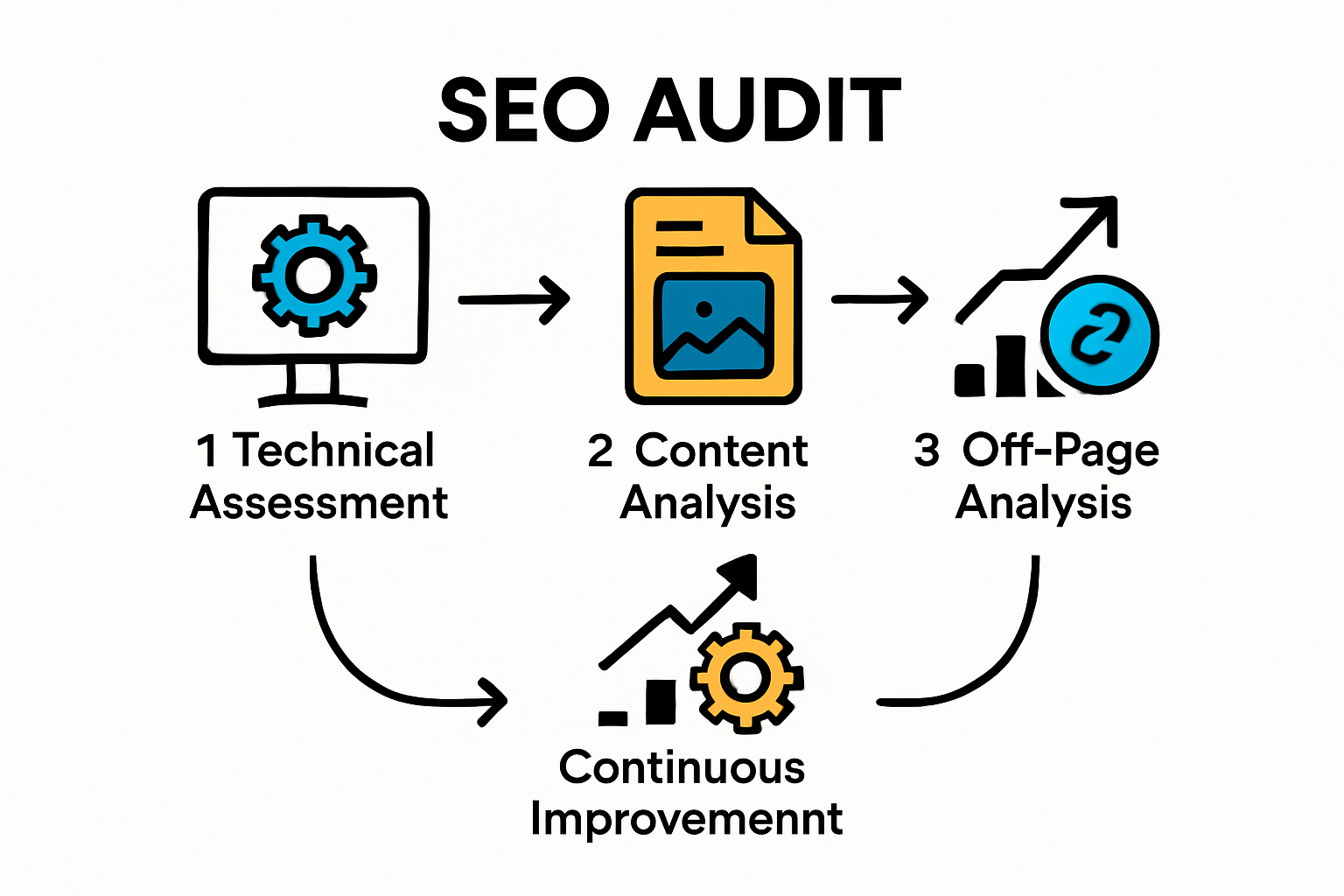
Performance Tracking and Continuous Improvement
An SEO audit is not a one-time event but a continuous optimization process. Google’s Performance Guidelines recommend establishing ongoing monitoring and improvement mechanisms.
Continuous improvement strategies include:
- Regular Performance Benchmarking: Monthly or quarterly comprehensive reviews
- Competitive Analysis: Tracking industry competitors’ digital strategies
- Algorithm Update Monitoring: Staying informed about search engine ranking changes
- Actionable Reporting: Developing clear, prioritized recommendations for implementation
Ahrefs’ Research indicates that businesses implementing consistent, data-driven optimization strategies can improve search rankings by up to 40% within six months.
By following this structured approach, South African businesses can transform their SEO audit from a complex technical exercise into a strategic tool for digital growth, ensuring their online presence remains competitive and dynamic.
Actionable Steps After Your Audit
Completing an SEO audit represents only the beginning of your digital transformation journey. For South African businesses, translating audit insights into strategic actions determines the difference between merely understanding your digital landscape and genuinely improving your online performance.
Prioritizing Technical Improvements
Technical SEO challenges often represent the most immediate opportunities for meaningful website enhancement. Google’s Webmaster Guidelines emphasize the critical nature of addressing foundational technical issues promptly.
Key technical priorities should include:
- Site Speed Optimization: Reducing page load times through image compression and code minification
- Mobile Responsiveness: Ensuring seamless functionality across all device types
- Crawlability Enhancements: Fixing broken links, improving XML sitemap accuracy
- Security Implementation: Confirming HTTPS protocol and SSL certificate validity
Search Engine Journal highlights that businesses addressing these technical elements can see significant improvements in search engine rankings and user experience.
Content Strategy Refinement
Audit insights provide a roadmap for strategic content development. Moz’s Content Strategy Guide recommends transforming audit findings into a targeted content optimization approach.
Content refinement strategies encompass:
- Keyword Alignment: Updating content to match identified high-potential search terms
- Meta Tag Optimization: Revising title tags and descriptions for improved click-through rates
- Content Gap Analysis: Developing new content to address identified user search intents
- Internal Linking Improvements: Creating more strategic connections between related content pieces
For Cape Town businesses, this approach ensures content remains relevant, engaging, and strategically positioned to attract target audiences.
Ongoing Monitoring and Adaptation
Successful SEO is a continuous process of measurement, adaptation, and improvement. Ahrefs’ Performance Research suggests establishing a systematic approach to tracking and responding to digital performance metrics.
Continuous improvement mechanisms should include:
- Regular Performance Tracking: Monthly comprehensive SEO performance reviews
- Competitive Benchmarking: Ongoing analysis of industry digital strategies
- Algorithm Update Responsiveness: Rapid adaptation to search engine ranking changes
- Iterative Optimization: Consistent, incremental improvements based on data insights
Neil Patel’s Digital Marketing Research indicates that businesses implementing consistent, data-driven optimization can improve search rankings by up to 50% within a year.
By approaching post-audit actions as a strategic, holistic process, South African businesses can transform SEO audit insights into tangible digital performance improvements, creating a robust and adaptive online presence.
Frequently Asked Questions
What is an SEO audit?
An SEO audit is a comprehensive evaluation of a website’s search engine optimization performance. It identifies technical issues, content gaps, and off-page factors that can affect visibility and rankings in search engines.
Why are SEO audits important for businesses in South Africa?
SEO audits provide critical insights into website performance and help businesses uncover hidden barriers to higher rankings. In South Africa’s competitive digital landscape, regular audits can significantly enhance online visibility and user experience.
What key areas should I focus on during my SEO audit?
Focus on three main areas during your SEO audit: technical infrastructure, content and on-page SEO, and off-page SEO (including backlinks). Each area plays a vital role in improving overall site performance and search visibility.
What tools are recommended for conducting an SEO audit in 2025?
For an effective SEO audit, consider using a mix of free tools like Google Search Console and Google Analytics, alongside professional platforms such as SEMrush and Ahrefs. AI-powered tools like Surfer SEO can also provide advanced optimization insights.
Elevate Your SEO Game with SEO Studio!
You’ve learned the importance of conducting comprehensive SEO audits in your business journey, uncovering those hidden performance barriers that hold you back from climbing search engine rankings. But what happens after your audit? Do you have the expertise needed to implement those technical fixes, refine content strategies, and adapt to ongoing changes? Fear not! That’s where SEO Studio steps in to bridge the gap.

With our dedicated SEO services tailored for businesses in South Africa, especially in the vibrant Cape Town area, we’re here to help you transform your insights into action. Our proven strategies — from keyword research to meticulous website optimisation and robust link building — ensure your digital presence is not just visible but thriving. Join the ranks of our satisfied clients who have experienced up to 40% ranking improvements through our results-driven approach. Don’t let your hard work go to waste; contact SEO Studio today and take that critical first step towards ensuring your online success NOW!